
Mode guide
F1 Reaction Time Test: Lights Out Reflex Challenge
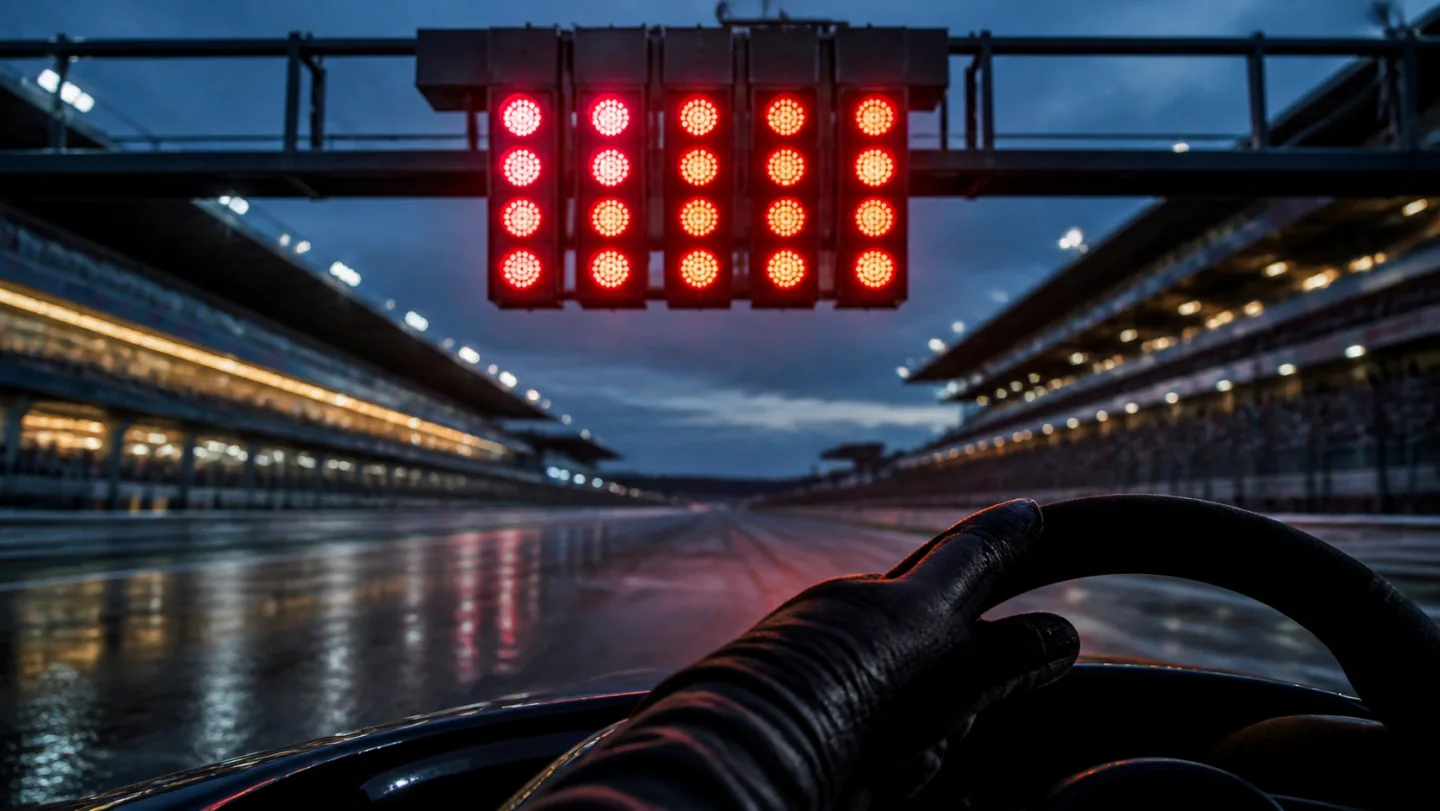
An F1 reaction time test is inspired by motorsport start lights. You wait for the start cue, then react as fast as possible without jumping early.
To put this topic in context, compare it with the visual reaction time test, try the average reaction time benchmark, and follow the reaction-time guide for gamers. The reaction time guide library connects every benchmark and test mode.
How the F1 lights reaction test works
The challenge starts with a waiting phase. When the cue changes, your click, tap, Space, or Enter press stops the timer. Multiple attempts are better than one result because anticipation and hesitation can change a single score.
What this mode does — and does not — reproduce
This page recreates only the wait-then-react pattern. It is not connected to a car, grid sensor, clutch, official start signal, or FIA timing system. In this game, any input before lights out is rejected; after lights out, the browser records the interval to your input. World Athletics uses a less-than-0.100-second start-information threshold for sprint starts, but that athletics rule is cited as an official example of anticipation control—not as an F1 threshold and not as a rule enforced by this test.
Tips for faster F1 reaction times
- Keep your finger or cursor ready, but do not pre-click.
- Focus on the start cue instead of trying to predict it.
- Use a consistent browser and input device for every practice set.
- Take breaks if your scores slow down after many attempts.
Frequently asked questions
What is a false start?
A false start is any launch that begins before the actual start signal, meaning the athlete or driver reacted to their own anticipation rather than to the real cue. In this test, clicking, tapping, or pressing before the lights change counts as a false start and should be retried.
How fast do F1 drivers react to lights out?
This browser game cannot establish a representative F1-driver range. An official launch also depends on the car, controls, procedure, start system, and sporting rules. Use the result for your own same-device practice, not as a claim that you match an F1 driver.
Can I get better at start-light reactions?
Yes, within limits. Practicing the wait-then-react pattern improves focus and reduces false starts, and familiarity with a consistent light sequence can shave a little time off your average. It will not make a genuine reaction faster than normal human reflex limits allow.
Practice the F1 mode in the main Reaction Time Test, then compare your result with the average reaction time guide.
Sources and measurement notes
These references explain the timing method and the limits of browser-based comparisons.